I EAT WITH MY EYES.
Updated: Jun 27
Taking photos on the street satisfies a different kind of appetite for telling stories.
I started exploring photography in the Philippines as early as 2009, but I only got into street photography a few years later when I wanted to try something new besides portraits, events, and corporate shoots. There is a large and lively street photography community in the Philippines, and I miss being part of it. I especially enjoy photowalks because I learn a lot from the people I meet, and they are genuinely enjoyable. Although I usually preferred exploring on my own, I sometimes took a friend or joined a small group for safety.
In Manila, safety can mean different things, but spending more time on the streets taught me how to look after myself. Even with an expensive camera around my neck or in my hand, I never really had problems, even when I probably should have. The street has its own kind of order that only people who spend a lot of time on sidewalks, crossings, corners, alleys, and public transport really understand.
What interests me is that the street never runs out of stories. Some are simple or intriguing, funny or sad; they become important details in a bigger picture, I imagine.
I was once interviewed by a friend, Pj, for his YouTube channel while we explored the city by taking the Philippine National Railways (PNR), the old train system in Manila. We talked about my photography and what street photography means to me. I wasn't ready for the camera because I thought we would just have a photowalk. Now I appreciate that he recorded it, even if watching it makes me cringe at the sound of my voice and the awkwardness of me being filmed. When people ask me about street photography, it’s my way to connect with the subjects and surroundings, but it also lets me step back, detached, and be a momentary observer. I can feel close to what I’m photographing and distant at the same time. That’s what street photography does for me. It excites and feeds me differently from the other genre of photography
Hangout for many, somewhere near the port of Manila Somewhere near the Pasig river Kids would often bath in public fountain especial in summer when it is super warm, Binondo, Manila Busy underpass somewhere in Hong Kong Hong Kong Public Market, Cebu, Philippines Intramuros, Manila
Earlier street photos, just roaming around different cities
THE STREET WITH NO NAMES.

In 2004, I made an experimental guerrilla short film called The Dead Letter. Damn, if my math is correct, that was 22 years ago. It was about a young writer walking through the streets to mail his script at the post office. My friends and I filmed on different streets, bridges, and alleys, and even inside the iconic Manila Central Post Office, which was burned down in 2023. I wasn’t doing photography yet then; I had just finished a scriptwriting workshop and was excited to bring my first finished script to life.
When I wrote the story, I envisioned it mainly in the street because it represents so many things for the main character. The outside world reflects his inner world as a writer. The street is a ready stage that doesn’t need fixing or additional props. It was the perfect setting for an almost no-budget film. We were practically novice filmmakers back then. Independent cinema was just beginning to gain momentum, especially among the younger generation
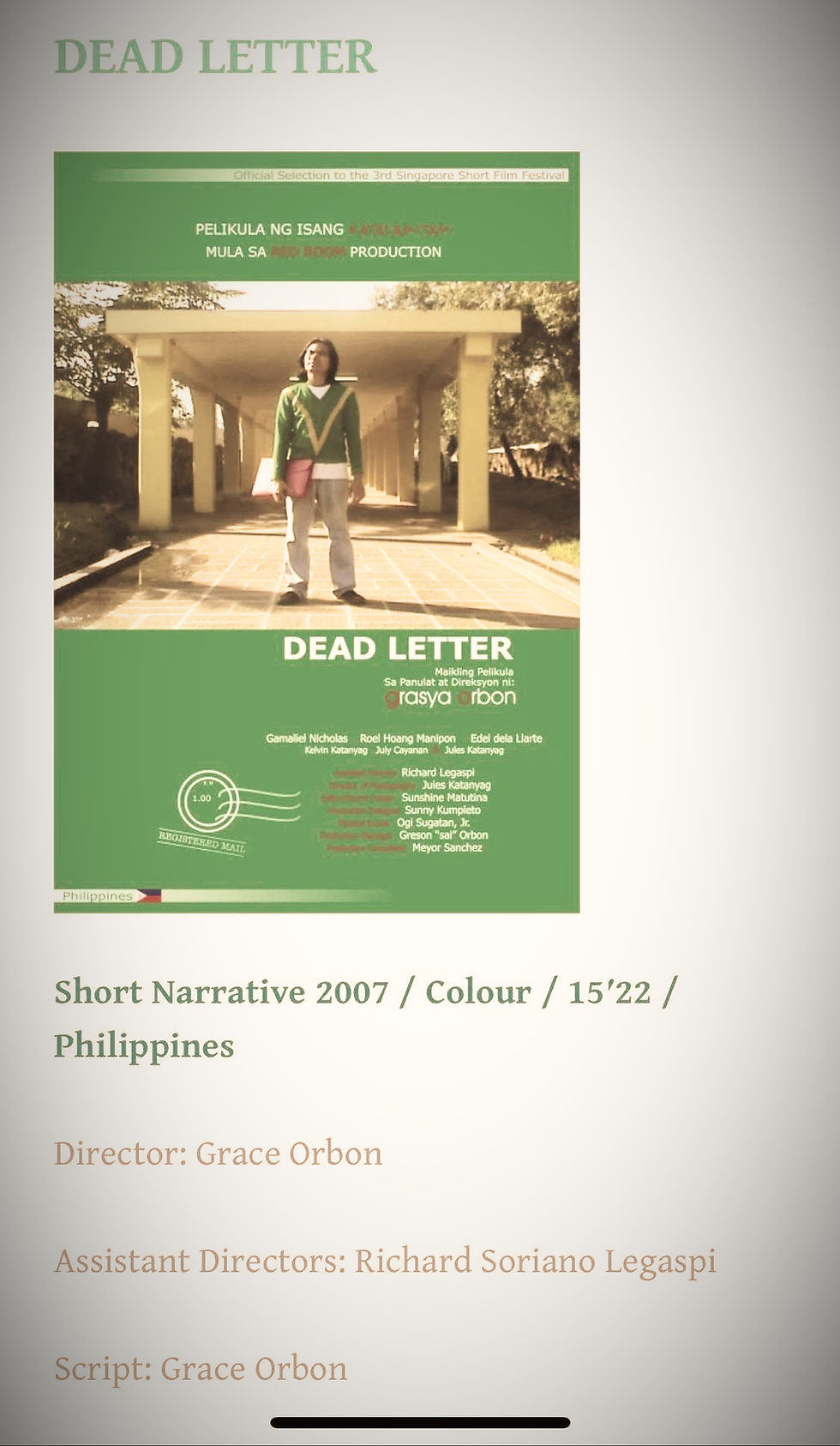

We were practically novice filmmakers back then. Independent cinema was just beginning to gain momentum, especially among the younger generation.
SIDE STORY.
In 2002, I was fortunate to be included in the Batch 14 Scriptwriting Workshop for Film & Television of Ricky Lee. He is the humblest and most generous person I have ever met in my life. A celebrated author, writer, and screenwriter, and the Filipino National Artist for Film and Broadcast Arts, was inducted in 2022. Sometimes I say it was just pure luck—or maybe even a mistake—to be included among his students, since I didn’t pursue a writing career and instead entered the corporate world. I remember there were hundreds of applicants for that workshop, but only 63 were chosen and split into Sunday and Saturday groups. It was fiercely competitive. I didn’t leave the house for almost three days because I was so anxious to find out the results. Every time he announces a new set of workshops, thousands of people apply, and it has become harder to get in as the numbers grow and the chances get slimmer. He has been running this workshop since 1982; it is free, and many of his former students and friends have contributed in various ways over the years to pay it forward.
My experience during and after the workshop has profoundly shaped how I see the world today, especially through my photography. What I learned from Ricky Lee goes far beyond writing; it applies to life itself. He wrote a book called Trip to Quiapo, considered the “bible” of Philippine scriptwriting. Remember Quiapo as you read this—it’s not just a place, but an analogy for many things.
The portrait I took of Ricky Lee remains one of the most meaningful photographs I have ever created. It was an honour, and I was overjoyed when he used it in one of his novels, Bahay ni Martha.
BACK TO THE STREET.
There are many reasons I love the street. It puts me in a dreamlike mood, like I’m watching a parallel world next to my own. The street is more than just a backdrop to take photos; it’s a space for reflection that can bring both happiness and sadness. It gives me a sense of connection, or sometimes even the comfort of being unnoticed, and there’s an excitement that’s hard to explain. Sometimes it heals you; sometimes it breaks you; and sometimes it makes you question your own world. Street photography is very reflective. I also like blending into a busy crowd, almost becoming invisible. The more time you spend in the middle of it all, the more you blend in. You stop being just a photographer and become part of the unfolding street life.
During a local election people are looking for their names and precint no. manually. A devotee of Black Nazarene Feast resting on a cement blockage The hard-working middle class would normally wait for the traffic jam to subside during rush hour; m
Photo 1. During a local election, people are looking for their names and precinct no. manually. Photo 2. A devotee of Black Nazarene Feast resting on a cement block. Photo 3. The hard-working middle class would normally wait for the traffic jam to subside during rush hour; meanwhile, I shoot.
Whenever I felt burned out from my corporate job or just exhausted by daily life, I would seek refuge in Quiapo, known as the Old Downtown of Manila. It is one of the city’s most historic districts, with a rich heritage that stretches back to the 1800s. Quiapo is a favourite destination for photographers in the Philippines. At its heart stands Quiapo Church, a baroque-style Minor Basilica and home to the Shrine of the Black Nazarene—a revered statue of Jesus Christ in the Catholic faith. Every January, the Traslación of the Jesús Nazareno draws thousands of devotees in an act of extreme faith and penance. The procession is intense and can be dangerous due to the sheer density of the crowd, jostling, and the risk of stampedes. Thousands walk barefoot for hours under the scorching sun, braving fatigue and dehydration. I only attempted to witness the crowd once, staying on the outskirts with my camera as an observer rather than a participant.

Photographing the Black Nazarene procession is a profoundly moving experience, even for someone like me who isn’t a devotee. I only tried to photograph the Traslación once—work or other priorities always seemed to get in the way, and the idea of being caught in the crush of the crowd was daunting. Having been baptised Catholic, attended an all-girls Catholic high school, and raised by a conservative, religious mother, this kind of devotion is deeply familiar to me. Participating in such a religious occasion can move you in indescribable ways. Religion, like politics, is a complex subject that many avoid discussing, but on the street it becomes a living, breathing event—on well worth capturing with a camera.
Feast of the Black Nazarene, Quiapo. Devotees clinging to the statue float. Mini replica of the statue. Devotees walking barefoot Crowd from the outskirts of the crowd
Photo 1. Feast of the Black Nazarene, Quiapo. Photo 2. Devotees clinging to the statue float. Photo 3. Mini replica of the statue. Photo 5. Barefoot devotees. Photo 5. Crowd from the outskirts of the crowd


QUIAPO.
Quiapo Church and the Plaza Miranda are iconic landmarks in the heart of Manila, surrounded by bustling flea markets, mosques, and a wide variety of businesses. The area teems with street vendors, the homeless, pedestrians, fortune-tellers, and devotees of diverse faiths. People from all walks of life—whether they call the streets home or are simply passing through—gather here, creating a space that is chaotic yet vibrant, brimming with energy and spirit.
Hidalgo, across from Quiapo Church, is the go-to street for photographers. That’s where the camera shops are, where you can print photos, check out film cameras, buy new or used gear, get repairs, or have your photos framed and pick them up the same day. Quiapo is a starting point for many photowalks or just a place to meet for coffee or street food. When I moved to Norway in 2022 and started looking through my old photos, I felt increasingly homesick. The contrast and street life that had once felt so normal to me now felt strange and out of reach.


Daily life, Pasig, Philippines Daily Commute, at the elevated metro station Devotees of the Black Nazarene Feast

THE STREET: The NorWay of life.
When I moved to Norway, my view changed from that of a tourist in 2019 to that of a resident in 2021. That shift affected every part of my photography. We moved to the countryside, and the new surroundings made me nervous before I even tried street photography again. The comfort I once felt in busy places was replaced by doubt, insecurity, confusion, and eventually sadness.
In 2024, I discovered Oslo Street Photography (OSP) and signed up to be a member. I was excited to finally find a community that holds my interests, something I really missed from home. I tried to attend a meet-up once and brought five printed photos to share. Normally, I’m very outgoing thanks to my Filipino roots, but after moving to Norway, I found myself becoming more reserved like the Norwegians. I live about an hour and a half outside Oslo, so it’s hard to join OSP activities like photowalks or meetings. Planning to attend was difficult due to proximity, work, and family. I was a silent member, as you can say. Two years ago, I wanted to go to the festival, but I had already organised a group of Filipino photographers and a painter for a self-funded outdoor photo exhibition called “Ito ay Tahanan,” which means This is Home. Unfortunately, it happened on the same day as the OSP festival, and I couldn’t change the date because it was a partnership. Missing the OSP event was really disappointing, but somehow the Filipino event went well, so all is good for me.
After taking down the exhibition, I cried in my car from exhaustion and mixed feelings of joy and a small sense of achievement. I started the Common Ground Kolektiv to fill a void in my being, but it was hard to keep up, so I set it aside to focus on my own work. Even though it’s on hold, I still keep it connected to ongoing collaborations. Smaller, slower steps, chasing nothing but deliberately meaningful collaborations like the 27 middle grey, an instant-camera chronicling of life in the diaspora, Baul ng pangarap (Trunk of dreams), a documentary about people who buried their dreams inside a trunk, in both metaphorical and literal senses. These are ongoing projects.

COME 2026.
A few months ago, I met Joakim on a sunny day in Oslo while I was out with my camera. We were both looking at a photo exhibition in front of the Storting building, Norway’s Parliament. I noticed his camera and started a conversation, which is always a good way to break the ice. I asked if he knew about OSP, and he did. He encouraged me to attend the festival. I wasn’t sure yet, but I said I’d consider it. What was supposed to be a solo photo walk turned into a nice conversation about photography, life in Norway, and more. It came across as a good sign to go to the OSP festival.
TAKEAWAYS.
It's kind of weird to tell people I have met at the festival how delighted I am to be there without giving any context. I may have sounded naive, a short little woman already feeling odd and shy, sitting or walking among tall people with cameras hanging from their necks or hands, ready to snap the moment. I’d be honest: I experienced a bit of strangeness, but as the day went by, the mood and vibe of the event didn’t feel so much like alienation at all. Maybe because the people at the event have a common denominator -photography.
It is a street-photography festival, but many attendees practice other genres. All sorts, and it was an amazing experience overall. For me, it was a fresh kick in the butt, literally, because, like anyone practising the craft, whether as a professional or as a hobbyist, goes through stagnation at some point. Hearing someone talk face-to-face about their loneliness, breaking the rules, being a small person, not belonging, feeling lost and shy, or just how they started and how tough or fun it is to be photographer is always an eye-opener. I felt the collective joy of just being in the OSP event.
I think the only thing that I didn’t like was how the chairs were arranged inside the venue. Such an OC kind of observation from me. Maybe because it is distracting to see people coming and going from the venue while someone is speaking on stage. People will have to pass through the middle aisle to reach the back or go up the mezzanine. It can be bothersome, but it's not really a deal breaker.
The line-up of speakers is fantastic, and the topics are on point. I wish I could talk to all the speakers or the other members during the breaks, but I guess there just isn't enough time for everything. I can only talk so much about my personal interaction during the event and what strikes me most. But a disclaimer, this is not a review of the event in any way. This is just me trying to recall the beautiful experience with the OSP event. I wish I had given this so much more thought. My idea was to emphasise the curiosity I felt when I discovered the OSP group. Also, I'm trying to sit down more often and write my thoughts like I did when I was 14, which is why I started publishing some of these. My brain is nearing its brain fog rotting point, so I need to do this frequently to save it.
I really like Andreas Feydt’s street photography, which reminds me of my good friends from back home. You just know by looking at those witty details captured on the street that they are wrapped with a trained eye. I seriously envy the level of discipline developed over the years, as I see the humour and timing at their best.
Also, listening to Joakim Möller was a stimulating take on visions that can work without paying so much attention to the gears and technology. Most photographers, if not all, suffer from GAS (Gear Acquisition Syndrome) or maybe a “Pixel Pepper”, prioritising technical perfection above artistic value at some point in their journey. It is a whole different discussion, but I am not here to dispute that.
I had so much interaction with Julia Coddington because I bumped into her in the toilet. It is always nice to see how other photographers work, and it was a pleasure to watch Julia operate on the street. I can relate not only because we are both small ladies, but she is raw and authentic. I swear I am not saying this because she gave me her coupon for a free beer at the bar. She was genuinely very nice, and I’m excited to know that she will visit the Philippines to check out the Traslación of the Black Nazarene. I’m excited about how Manila will look from her perspective.
I really wish I had more to say about the other speakers, but they are all great and very talented photographers. Whatever is said here doesn’t really matter. These are just my meandering thoughts on why I like street photography, how it started, and how it developed into other things. The people I met at the event, the speakers, somehow revived what’s left in my box of curiosity. I also want to say that Taras Bychko said something important that resonates truly, “If you keep making the same photographs, you are no longer discovering”. It stayed with me, and I’m sure to remember that.

The streets I’ve been to have changed a lot and are constantly changing; a world saturated with visuals from phone cameras alone is drowning. I think I heard from someone, somewhere, that smartphones killed street photography. Again, that’s not the point of what I am writing about. Street photography may be reduced to trillions of pixels, but it will definitely remain a means of seeing, feeling, connecting, interpreting, and reflecting on an experience through a camera. That cannot be diminished.
For me, it remains the same: the street is a public place where all of us unknowingly connect and disconnect with each other, and there will always be a woman like me who would like to say something about it or shoot it, obviously, just one click at a time.


Words and photographs by:
Grace Orbon-Emmelot is a photographer and artist in Norway. She focuses on storytelling through portraits, streets, documentary, travel, events and landscapes. It features visual narratives that blend Filipino roots with Norwegian life and diaspora life, emphasising cultural stories, migration themes, and emotional connections.

Comments